
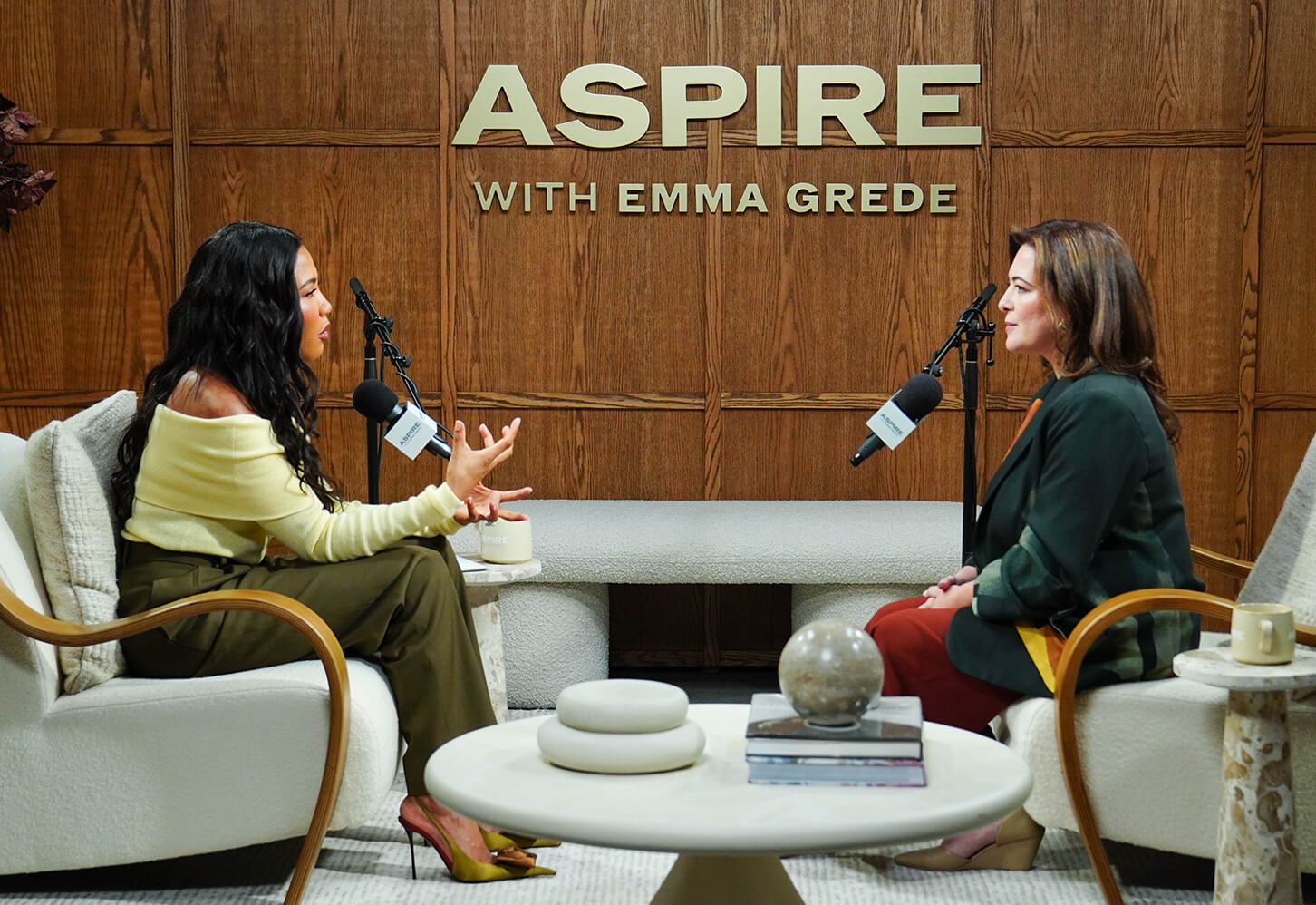
Tara Mohr on Aspire with Emma Grede Podcast
Watch the Episode
In Tara Mohr’s conversation with Emma Grede on Aspire, we talked about why the inner critic can be so loud, how to hold onto your vision and your voice anyway, and why every woman must define Playing Big for herself. Watch or listen for a candid, thought-provoking conversation that will leave you knowing how to start playing bigger in your life and career.
Listen to the Episode
What Were the Main Topics Tara Mohr and Emma Grede Talked About on the Aspire Podcast?
Tara Mohr and Emma Grede talked about:

Quieting the inner critic
Finding your inner mentor
Unhooking from praise and criticism
Workplace feedback that women often receive
Discovering and pursuing your callings
Key Takeaways from the Conversation
1
A lot of us have the sense that we are playing small. You are not alone!
2
Playing Big looks different for each of us – because playing big is about being more loyal to your dreams than your fears. Only you know what your true dreams are. For some women it’s starting a business. For others it’s asking for the promotion. For others it’s writing the book, or making their art and sharing it. For some, it’s simply creating a more authentic, fulfilling life – one aligned with their real values and unique self.
3
Playing big involves pursuing your callings, the way you feel called to bring goodness and light into this world in some particular way. But it can be really scary to go for our callings. All of us need to move through fear and self-doubt to get there.
4
We all have a tough, often mean inner critic! Research shows that women achieving incredible things haven’t eliminated the voice of self-doubt – they’ve just learned how to not have their inner critic be in charge of their decisions or their view of reality.We don’t need to wait on perfect confidence. In my work, we’re aiming for a wiser, effective relationship with self-doubt. We can get that by using simple practices in the moment when self-doubt comes up.
5
Every single one of us has an incredible, centered, guiding voice of wisdom in ourselves – we probably just haven’t discovered it yet! We can all discover our own inner mentor, just like Emma discovered hers during the show.
Once you know her, she can guide your decisions and life in remarkable ways.
Go Deeper
How to Know if You’re Playing Small
Playing small has nothing to do with not doing the things that look “big” in the world’s eyes. It’s more about that true, heartfelt sense of “I know I’m holding back, letting fear win out” when it comes to my dreams, my voice, what I really want to do in this life.
A lot of us feel that internal knowing that we are playing small. We know we are holding back, self-censoring, procrastinating, compromising ourselves even before anyone else asks us to.
In fact, one of the stories I often share is that when I first started writing a newsletter, and I asked women what they felt the #1 challenge in their lives was, the most common answer was “I’m playing small.” More women checked the box on that than on issues like work-family balance, relational challenges, or stress – the things we so much more commonly talk about as key challenges for women today.
Here are Some Other Signs that Often Show Up When We’re Playing Small:
Life starts to feel dulled, with a kind of absence of color and vitality.
You have an idea for a project or new creation that you keep rationalizing away or telling yourself you aren’t xyz enough to carry out – but sweeping that idea away doesn’t sit right with you.
You hide out in ever-more learning or preparation, and you rarely take leaps and do small experiments that have you stepping into your dreams.
You’re passionate about your work but you struggle to share, promote, or stand for the value of it.
You follow lots of other voices but you have trouble finding, trusting, and sharing your own unique point of view.
When you encounter someone who is boldly doing their thing, you feel jealous or compelled to criticize.
You aren’t doing the practices that bring you joy.
Still Figuring Out What Playing Big Looks Like for You?
Great question. Start with these simple steps.
Welcome the wisps of inspiration
Even if your dreams don’t seem realistic or defined enough, welcome the ideas, images, and wisps of inspiration about the direction you want to go. Knowing a general direction – maybe for you, it’s simply more meaning, more creativity, more community, or more fun – that kind of general direction is enough of a place to start your playing bigger journey!
Recognize, too, that sometimes the life we are longing for doesn’t reveal itself in a job title or complete life plan. It often shows up through images. Ask yourself what your ideal day or longed-for life would look like. Close your eyes and let yourself imagine. What scenes or images do you see? Those are enough to get you started on the path too.
Name and notice your inner critic
Start a practice of naming and noticing your inner critic, your inner voice of self-doubt. What does it commonly say to you? How does it show up when you are going for a stretch or goal that matters to you?
Start to notice the inner critic voice and use tools to quiet it.
Get practical tools for quieting your inner critic — straight from the book.
Meet your inner mentor
She can guide you, help with big decisions, and help you define your life and career vision — just as she did for Emma on the show, and just as she has for the hundreds of thousands of women who have met theirs through the Playing Big book and courses.
Discover the wise, future version of yourself through a guided visualization.
Your Calling Isn’t One Big Answer – It’s What Pulls You Right Now
We live in a flawed world, a world full of woundedness and pain. There are so many corners of that world that need care, creativity, improvement, innovation.
But of all the needs in the world, all the issues that need attention, the problems that need solving, some particular ones will call to you more than the rest. They keep you up at night. They inspire your ideas. They ignite your energy. They make something inside of you say: Yes, that. I feel called to work on that.
It helps us a lot when we make a fundamental belief shift: instead of thinking the world shouldn’t have all these problems already, we realize that actually, this is a deeply imperfect realm, and we are all here to make our contribution to it.
If You Aren’t Sure How to Pursue Your Calling
Perhaps it feels like you’re too busy, too exhausted, don’t have the right training or enough resources.
So many of us are faced with this dilemma: on the one hand, there is some project we feel called toward – maybe to start that school teaching kids music, to make a career shift, to write the book. On the other hand, we’ve got our current responsibilities. The job that pays the bills. Kids to raise or other family members to care for. Financial constraints.
If you have those concerns, here are THREE TIPS to consider:
1
Check if the conflict is real.Ask yourself if there really truly is a conflict between your dream and your life circumstances. Sometimes, limiting beliefs cause us to think our two goals are incompatible when they really aren’t. Do a double check: is this absolutely true? What’s another way to look at it?
2
Check if the real issue is fear.Often, we’re afraid to pursue the dream (because like all dreams it will ask us to risk failure and take us out of our comfort zones) and so our brain helpfully makes up lots of reasons to put action on hold – including that the dream just isn’t doable given our current responsibilities.
If that’s part of what’s happening for you, get out your journal and write down all your honest fears. Then find your inner mentor using the guided visualization, and ask her for her feedback on those fears.
3
Ask yourself, “What is the form of this calling that could have existed 1,000 years ago?” This helps us get to the essence of our calling.
For example, 1,000 years ago, you wouldn’t feel called to be a school principal, but you might feel called to teach kids or to lead others who teach kids. 1,000 years ago you wouldn’t feel called to run a graphic design agency (because those didn’t exist!), but you might have still felt called to create beautiful visuals and lead others in doing the same. 1,000 years ago you wouldn’t have felt called to design an amazing mobile app for busy working parents, but you might have felt called to serve families in making their lives easier.
Once you’ve got your 1,000-year-old form of this calling, brainstorm ways you can live out that essence today. Maybe it’s the conversation you host with friends this week, or the volunteer role you take on, or the small project you launch in the simplest way.
Every one of us can live out the essence – the 1,000-year-old elemental core – of our callings in our current lives.
Ready to Start Your Playing Big Journey?
Inner Critic Freebie
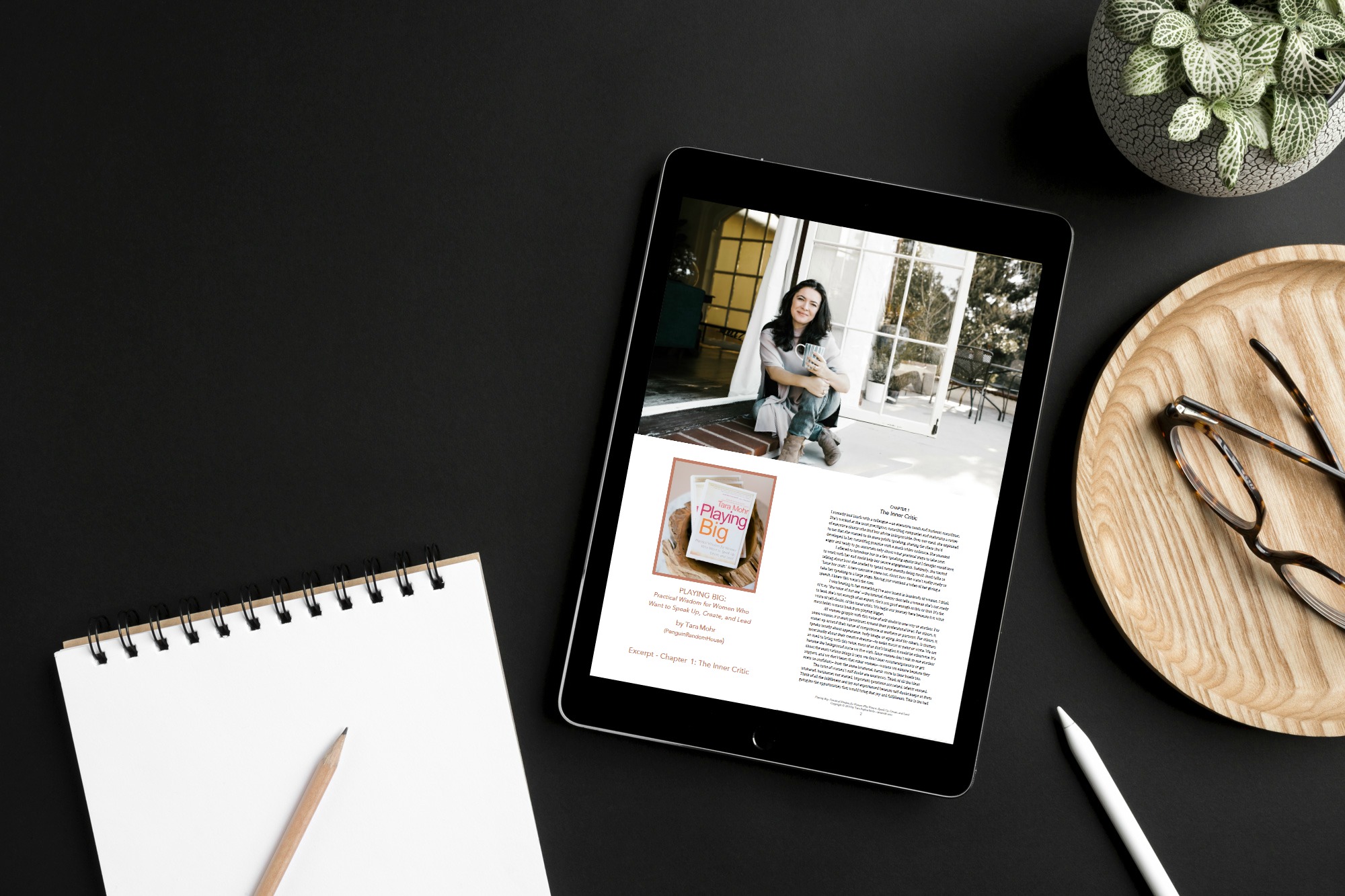
Get this free chapter from my book, Playing Big, and learn the unique approach that’s been featured in Oprah.com, The New York Times, and goop.
Get Your Freebie
Read the Playing Big Book
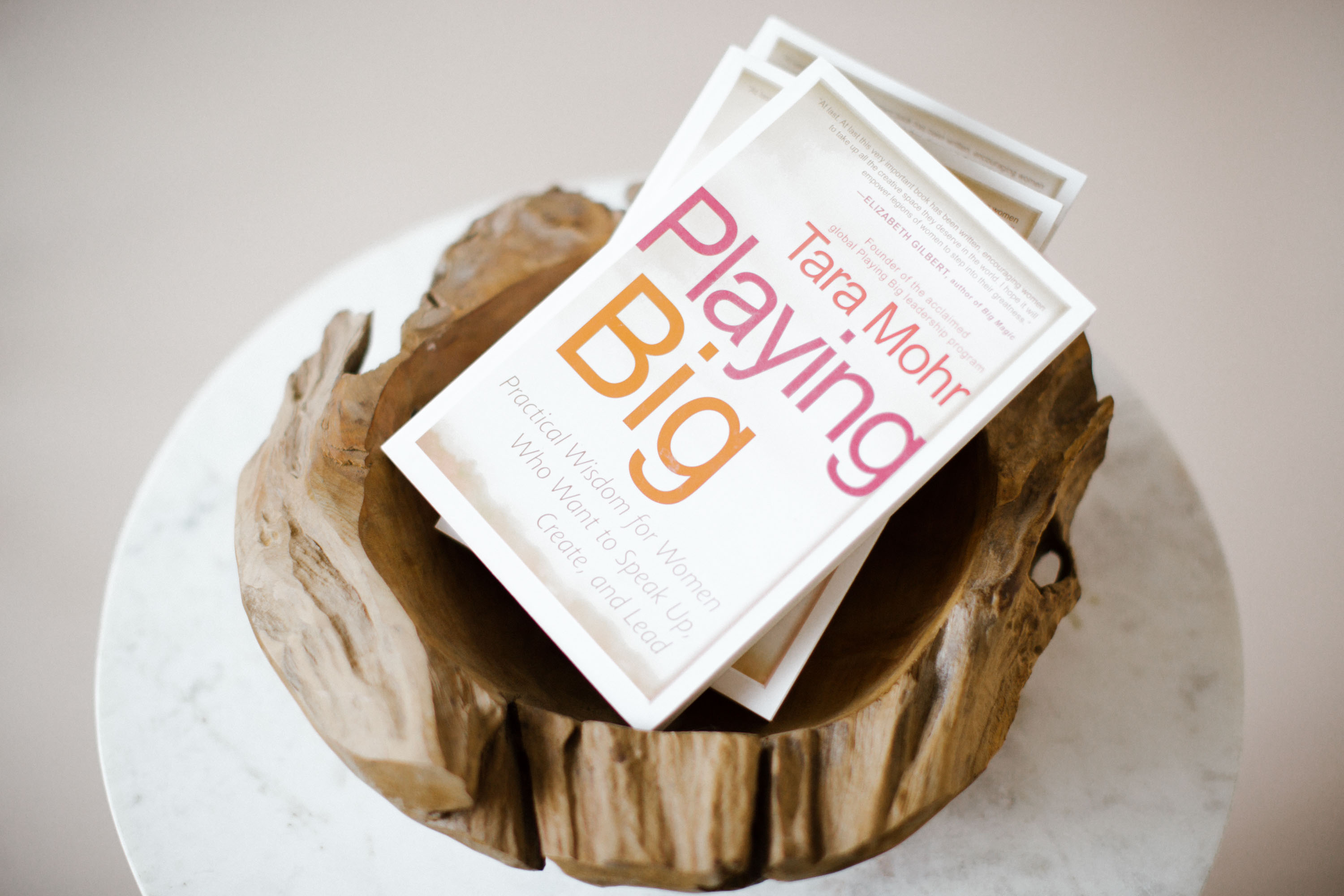
The catalyst for transformation that Forbes calls “A must read for any woman who wants to find and use her voice to make her mark in the world.”
Read the Book
Read the Blog

Explore a rich library of articles and inspiration, from quieting the inner critic to making bold life changes, creativity, spirituality, and communicating with clarity.
Read the Blog
FAQs
Where can I listen to Tara Mohr’s interview?
Tara Mohr’s interview on Aspire with Emma Grede’s podcast is located on YouTube, as well as Spotify and Apple podcasts.
How does Playing Big help you “Start with Yourself”?
Emma’s book is all about how inner work – starting with your own thoughts and goals – has helped fuel her success. Tara’s work dives deep into that inner work, with a focus on helping women work through what’s keeping them playing small, so that they can pursue their dreams.
Playing Big breaks this work down into key areas: quieting the inner critic (rather than waiting on perfect confidence), finding your inner mentor (rather than turning only to external role models), unhooking from praise and criticism, and identifying your unique callings – not chasing the world’s definition of success. Tara & Emma are both interested in how women can move beyond old patterns and societal conditioning to claim more of the lives that will bring them fulfillment and joy.
How can I find my inner mentor?
We’re so glad you asked! It’s such a transformative, powerful thing to meet and get to know your inner mentor. Access Tara’s guided visualization to find your inner mentor here.
Where can I buy the Playing Big book?
Most places where you buy your books will carry or can order Playing Big. Here are links to buy the book at Amazon, Bookshop.org, Barnes & Noble, or Apple iBooks.
If you’d like the audiobook, you can get it here.
Can I do a coaching session with Tara?
Tara isn’t currently doing 1:1 work – the best way to get experiential, in-depth support is through the renowned Playing Big Course. In the course, you get access to all kinds of materials, live sessions with Tara, our amazing global community, and more to work toward your playing bigger. Learn more and sign up to get information on the program here.
I’m a coach and want to bring Playing Big to my clients.
You aren’t alone. Many coaches are passionate about supporting women – whether in entrepreneurship, leadership or wellbeing. Tara’s programs for coaches, therapists, managers and mentors have trained thousands of people to use the Playing Big toolkit with others. They’re also ICF-accredited continuing education programs for coaches. You can learn more about our Playing Big Facilitators Training and get on the advanced notice list for our next session here.
I want to start a Playing Big book group
Great! That’s a great way to propel yourself and others forward in your playing big! People start Playing Big book groups with friends, family members, or workplace groups. We have an easy to use set of Discussion Guidelines for Book Groups here.