

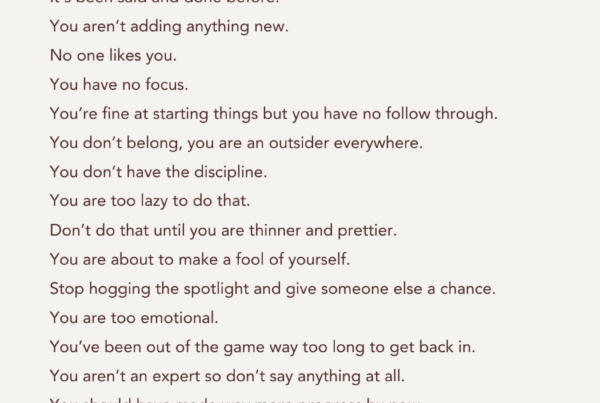
Brilliant women often wonder: well, how do I know if I’m hearing my inner critic, or if I’m just being realistic?
Is that my inner critic telling me that I am not ready to start the business – or is that realistic thinking?
Is that my inner critic telling me that I won’t find a commercial market for my art – or is that simply the unfortunate truth?
Is that my inner critic telling me that I shouldn’t apply because I’d never get the job – or is the voice of wise realism?
These are really good questions.
Please know, I’m all for realism. I believe in bringing our practical assessment of reality to bear in every decision. I have an MBA for goodness sake!
The good news is, there is a simple and fast way to tell whether you are hearing from the voice of your inner critic and the voice of realistic thinking. In this video (3 minutes) I share what it is.
Quieting self-doubt is one of the topics we cover in-depth in my women’s leadership program, Playing Big. The program is a journey to help you Play Bigger – in your work and your life. Hundreds of women have participated and seen incredible results in their businesses and lives. For details about the program, click HERE .
Love,
Tara






This is absolutely brilliant Tara! Thanks so much for this wonderful video 🙂
There’s a big difference between that critic talking, and realistic thinking.
This is deeply helpful, Tara. I would add that the anxious, non-solution oriented thinking of your inner critic can also be distinguished when it leads you back to old stories of past failures or self-limiting identities (“I’m just not the kind of person who can pull this off”, etc.) It’s an endless loop vs. forward motion, as you pointed out. Thanks again for an awesome post.
Tara – by far one of the best explanations I have heard for determining who is talking. I loved it! I can think back recently of my realistic thinking trying to help me do the practical things that need doing.
I also think sometimes the inner critic is really fear speaking. I sometimes take a moment to sit with the fear and see what it is trying to say. I let it know that I have it handled. : )
OMG… this has been a question that has toying with me for such a long time. I love this way of looking at it. I think this concept will help in so many ways…. the biggest of which I think it will encourage me to identify a solution even when the inner critic starts her ranting…. could it be that I could mindfully convert the inner critic into a solution finder??? Thank you.
Thanks for this Tara! The examples you gave were a really clear way to describe how to distinguish between the critic and realistic thinking. What opened my was the idea that our best “realistic thinking” is thinking that moves us forward into achieving our dreams in a way that works well for us. It’s not something that holds us back. Sometimes the word realistic gets a bad rap. Thanks for the reminder that being realistic doesn’t mean you’re not still going for what you want-you’re just doing it in a positive, sustainable way.
I’m really enjoying the theme/design of your weblog.
Do you ever run into any internet browser compatibility problems?
A couple of my blog audience have complained about my site not working correctly in Explorer
but looks great in Safari. Do you have any suggestions to help fix this issue?
Hey there I am so excited I found your site, I really found you by
error, while I was searching on Yahoo for something else, Nonetheless I am here now and would just like to say thanks for a remarkable post and a all round entertaining blog (I also love the theme/design),
I don’t have time to read through it all at the moment but
I have book-marked it and also included your RSS feeds,
so when I have time I will be back to read more, Please do keep up the awesome b.
I’m really enjoying the design and layout of your website.
It’s a very easy on the eyes which makes it much more
pleasant for me to come here and visit more often.
Did you hire out a developer to create your theme?
Superb work!
Actually no matter if someone doesn’t be aware of after that its up to
other users that they will assist, so here it happens.
Hey I know this is off topic but I was wondering if you knew of
any widgets I could add to my blog that automatically tweet my newest
twitter updates. I’ve been looking for a plug-in like this for quite some time and was hoping maybe you would have
some experience with something like this. Please let
me know if you run into anything. I truly enjoy reading your blog and I look
forward to your new updates.
Howdy! This is my 1st comment here so I just wanted to give
a quick shout out and tell you I truly enjoy reading your articles.
Can you suggest any other blogs/websites/forums
that deal with the same topics? Thank you so much!
I blog frequently and I seriously appreciate your
information. The article has truly peaked my interest.
I’m going to book mark your site and keep checking for new information about
once per week. I opted in for your RSS feed as
well.
Hi, i believe that i saw you visited my site thus i got here to go back the desire?.I’m trying to find issues
to enhance my web site!I assume its ok to make use of some of your ideas!!
Hi there very nice blog!! Guy .. Excellent .. Amazing .. I’ll bookmark your website and take the feeds additionally?
I am happy to find a lot of useful information right here within the
submit, we’d like develop extra strategies on this regard, thank you for sharing.
. . . . .
excellent issues altogether, you just gained a new reader.
What could you recommend in regards to your submit that you just made some days ago?
Any certain?
Do you have a spam problem on this site; I also am a
blogger, and I was wanting to know your situation; many of us have
developed some nice practices and we are looking to exchange techniques
with other folks, please shoot me an email if
interested.
What’s up, everything is going sound here and ofcourse every one is sharing information, that’s really good, keep up writing.
It’s very simple to find out any matter on net as compared to textbooks, as I found
this paragraph at this site.
Hello, There’s no doubt that your site could be having browser compatibility problems.
When I look at your web site in Safari, it looks fine however, if opening in Internet Explorer, it’s got some overlapping
issues. I simply wanted to provide you with a quick heads up!
Besides that, great website!
If some one wants expert view about running a blog afterward i
suggest him/her to visit this blog, Keep up the pleasant job.
you’re really a excellent webmaster. The website loading speed is incredible.
It seems that you’re doing any distinctive trick.
Moreover, The contents are masterwork. you have performed a excellent process on this
matter!
Fantastic goods from you, man. I’ve understand your stuff previous to and you’re just extremely great.
I really like what you have acquired here, really like what you are
stating and the way in which you say it. You make it entertaining and
you still take care of to keep it smart. I cant wait to read far more from you.
This is actually a tremendous website.
Excellent post! We will be linking to this particularly great post
on our website. Keep up the great writing.
It’s really very complex in this full of activity life to listen news
on Television, thus I only use internet for that reason, and
take the most recent information.
Great topic…Very helpful for people who gets low when others judge them.Will Share it on my FB profile.