For more than 15 years, I’ve been helping people fulfill their dreams in work and life through the groundbreaking Playing Big model for discovering your callings, and quieting fear and self-doubt.

But in recent years, I kept running into another issue that was holding back the women I was coaching: unhealed hurts. Not the major traumas, but the seemingly more moderate hurts, including those that happen at work.

Those hurts were holding back the women I was coaching, leaving them with execssive rumination, a real loss of confidence and energy, disrupted sleep, and ongoing pain.

So, I developed a process of healing from such hurts—so that we can fully restore our motivation, optimism, and connection with others.

That process has produced remarkable results for hundreds of diverse individuals, applying to both workplace and personal hurts.


What is Hurt?

Hurt is the painful experience of feeling uncared for, unloved, or disrespected by someone from whom we wanted love, care or respect.

Everyday hurts include:

the painful rift with a former collaborator
the boss that undermind us
the painful distance from a friend
the judgmental comment from a relative

We all need a toolkit to come out of everyday hurts whole and well.

Who is this work for?

Anyone who left a team, job, or industry because of a hurt, or who is finding themselves less motivated at work because of a difficult relational experience there.
Anyone who is working with people who are dealing with their own hurt—anyone who works with people who show up defensive, numbed out, attacking, or people-pleasing.
Practitioners, such as coaches and therapists, you want powerful practices, questions, and tools you can use when someone comes to you with a hurt, rift, rejection, or resentment.

Who is this not for?

This work isn’t built for processing trauma. It’s not a good fit if that’s the kind of hurt you are hoping to address.

Workshop Participants Share:

This process made such a positive difference for me. I no longer felt vindictive or judgmental; I just had a peaceful understanding of the situation.

I feel so grateful because a big burden has been lifted. It’s such a simple, elegant tool. It made the inexplicable explicable.

Before, the hurt felt like a 7 or 8 on a scale of 1-10. Now it’s more like a 3. It feels much less about me or a condemnation of who I am.

Wow…. It’s gone. The hurt really has gone.

I feel so much more compassion and less anger toward my family. And I feel much more confident in myself and my intuition.

I felt immediate spaciousness and ease where previously there had been ache and tension.

What You’ll Learn

Hurt 101

You’ll learn:

what the human emotion of hurt is

why it’s been so neglected in psychology research and our popular conversation

the top 10 causes of hurt

fascinating new research on how emotional hurt shows up in the brain and body

the problematic ways that hurt feelings activate the threat response in us

why we need a healing response instead

what that healing response must involve to truly help us

How to Heal A Hurt

You’ll learn four pillars, and a simple process, for working through your own hurts so you don’t have to live with long-term pain, resentment, fear or loss of energy from a hurt.

Use this process with both recent hurts and old ones, and the inevitable hurts yet to come, as a part of being human.

Pillar
1

Knowing, Naming and Feeling Your Hurt

How to know when you are hurt, even if it’s covered over by other emotions.

Simple questions, word lists and concepts that help you put hurt feelings into words.

How to slow down and feel the hurt, and why it’s so important to do so.

What to do if you realize a new hurt is really just an echo of an older, deeper hurt.

Somatic, visualization, and journaling processes that can help you move through hurt feelings.

Pillar
2

Clear-Seeing

Learn how to get out of blame and “othering” by asking powerful questions that allow us to see the other party’s hurtful behavior in new ways.

How to have strong self-care and boundaries—without needing to make anyone else the bad guy to do so.

Pillar
3

Finding Agency

So often, we continue to feel wounded, defensive and scared after a hurt. You’ll learn how to get your sense of safety and calm back by discovering your power and agency in the situation of the hurt, and in others like it. Powerful journaling and coaching questions help us see how we could show up differently in similar situations in the future.

Pillar
4

Taking Action

So often, we continue to feel wounded, defensive and scared after a hurt. You’ll learn how to get your sense of safety and calm back by discovering your power and agency in the situation of the hurt, and in others like it. Powerful journaling and coaching questions help us see how we could show up differently in similar situations in the future.

You’ll also learn my powerful tool, Love 360, a unique method for finding a path forward that’s loving toward both self and others.

ALSO INCLUDED

Love 360

You’ll also learn my powerful tool, Love 360, a unique method for finding a path forward that’s loving toward both self and others.

The Hurt in Your Midst at Work and Beyond

All of us work and live with people who are carrying unhealed hurt.

When they are feeling hurt, they’ll likely react in the ways we instinctively do: we attack, we defend, we shut down, we appease and people-please, or we leave or avoid.

Learn to work, relate, or lead wisely in the face of that, including:

How you can disrupt escalating cycles of mutual hurt.

How to show up when someone feels hurt by you—what is most needed, and tools for making apologies and amends when appropriate.

Why sleep, nutrition, hunger, rest and rushing are all in fact critical factors when it comes to hurt—and the practical “do’s” and “don’ts” based on that research.

How to design and lead anything in your life—from a family trip to a board meeting—in a way that’s more hurt-aware and hurt-wise, alert to what’s likely to cause hurt, and how to lead effectively and with love instead.

How to show up in your life in ways that are less likely to cause hurt – including the very surprising ones.

Healing Hurt Practitioner Training For Coaches & Therapists

In our practitioner course, we’ll dive deep into how to apply this model in your work with others, including:

Common signs and signals that you need to work with an unhealed hurt in a client or patient.

Key distinctions between everyday slights, moderate hurts and trauma, including the current diversity of views about those distinctions.

Tools, questions and prompts to help people identify their hurt and fully feel their feelings around it in a supported way.

The unique and surprising questions we can ask as coaches or therapists to help people reframe and reappraise experiences of hurt so they are much less painful and wounding.

A single-session or multi-session process for working through a hurt.

Exploration of how this model can work in group settings.

Becoming Unhurt Resources

What does it mean to feel hurt?

By Becoming Unhurt

One of my favorite things to do in my work is to take a core human emotion or experience and teach a “101” workshop about it. Inner Critic 101. Fear 101. Difficult Conversations 101. I’m a passionate believer that we all need a 101 education on many of the everyday emotional and psychological matters of our lives. I still can’t believe…

Read More

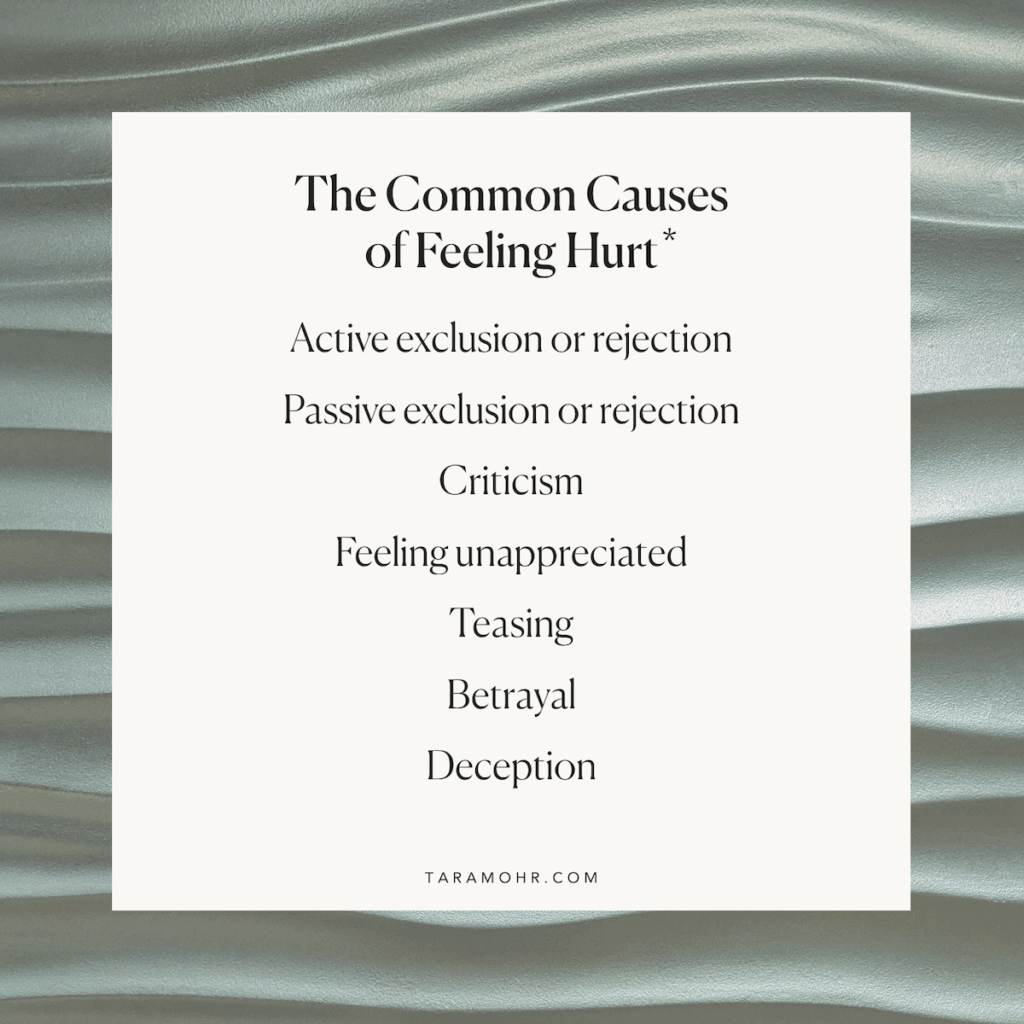
Why Do We Feel Hurt? 7 Reasons, and Then Some

By Becoming Unhurt

What makes us feel hurt? Psychology researchers have sought to come up with a list of the causes of feeling hurt. They created that list for further research and study on the types of hurt, but I immediately grabbed onto that list as itself a kind of personal growth tool. I find it immensely useful in my own life, and…

Read More

The Neglected Emotion

By Becoming Unhurt

“Oh yeah, they call you chickenlegs. Because your body looks like a chicken—you know, super skinny legs and a big stomach on top.” I was fourteen years old when a boy at school said this to me, while we were standing on the quad between classes. I was already immersed in diet culture, trying to change my body, knowing it…

Read More

About Tara

Tara Mohr is an expert on leadership and well-being. Her work helps people define and pursue their own playing big, both in career and in life. She is the author of the long-running, bestselling book, now a classic in the fields of women’s leadership: Playing Big: Practical Wisdom for Women Who Want to Speak Up, Create, and Lead. Playing Big is published by Penguin Random House, and was named a Best Book of the Year by Apple’s iBooks.

Tara is the creator of the global Playing Big leadership program teaching people skills for greater impact and fulfillment. She also trains managers, mentors, and leaders to use the Playing Big model in supporting others, through her Playing Big Facilitators Training.

Tara’s work has been featured on The Today Show and in publications ranging from The New York Times to Oprah.com to Harvard Business Review. She lives in the San Francisco Bay Area and loves dance, art, and long walks with her family.

Get To Know Tara

Sign up for resources & upcoming course offerings on Becoming Unhurt