
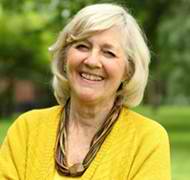
Well, she is one of the most widely read US women columnists in the United States. She has the ability to sum up a whole movement, a whole era, or a complex reality with a single, perfect line. Recently I had the honor of sitting down with remarkable woman Ellen Goodman. You can listen to our chat via audio (links at the bottom of the post) or read the transcript here. This is Part I of our conversation.
TARA: I’m honored. I’ve had butterflies in my stomach for the past few minutes. I’m just so delighted to have Ellen Goodman with us today!
ELLEN: I promise you I won’t be scary.
TARA: Ellen Goodman is one of our most wise and most widely read columnists. She’s a Pulitzer Prize winner and was the first to open up the Op-Ed pages to women’s voices. She has written extensively about social change in America specifically about the women’s movement.
Ellen began her career as a researcher for Newsweek magazine in the days when only men wrote for that news weekly, and then went on to have her own column which has been widely syndicated all over the world for several decades.
More recently, in 2010 she founded The Conversation Project. The purpose of that project is to make it easier to initiate conversations about dying and to encourage people to talk with their loved ones about their end-of-life wishes.
Ellen, thank you for joining me today.
ELLEN: It’s my pleasure.
TARA: There’s a quote from one of your columns that made me exclaim, ‘how does she just capture the spirit of a whole movement so succinctly and so beautifully?’
You said, “My generation of women thought the women’s movement would advance on two legs. With one, we would kick down the doors closed to us. With the other, we would walk through changing society for men and women. It turned out that it was easier to kick down the doors than to change society.”
Can you share a little bit more about that?
ELLEN: I think when we first began the women’s movement, there was this sense that the women’s movement was kind of 10-point program. It would be reproductive rights. It would be equal pay for women. It would be childcare. When we checked off that list, we would be done. But as you discover, every change that you make makes for more changes that are needed. Also, I think that it was easier to open up college and law school and medical school to women than it was to transform the way that those institutions work.
You have a situation where as long as women’s lives are exactly like those of men, you can have equal pay but in fact women’s lives generally aren’t exactly like those of men. You have a situation, for example, where as long as nobody is a caregiver, you’re all treated equally. But when men and women want to take care of their children or increasingly their parents, they run into that other wall, which is the social change wall. That one example of caregiving can be repeated across the spectrum of a million different things.
TARA: What I find so fascinating and troubling about that is for my generation it was like, ‘oh everything is fine now — things are equal.” It took me a long time to understand that I was still in a very patriarchal institution — at college for example – because the institutions hadn’t been transformed with coeduation.
I think for so many women we actually get a bit confused and it can result in feeling very alienated from ourselves. We’re operating in a system that we think is supposed to work fine for us and it takes a long time to see that the ways things are setup don’t work for us, don’t resonate with who we are, don’t fit with women’s lives…
ELLEN:One of the things that I have seen happen is that when you do run into barriers, you tend to think it’s your fault because you’ve been told that the barriers are down. If you experience them then you think, ‘hey, it’s just me. Why can’t I overcome these barriers?’ That is sort of where my generation began. We began thinking we were having individual problems — but then we came together during the women’s movement and started talking to each other.
This very much relate to where we are with The Conversation Project — so hold this thought. We came into collective groups and we started sharing our experiences and guess what, you know, there was that click of recognition, there was that understanding, “No, I’m not the only one. We’re all having this experience.” That click of recognition and that connection produced a lot of the social change.
And then fast forward, we’re living in a different era now. We’re living in an era when people are again more isolated. We’re back all the way through to people once again thinking, “It must be my fault. Out there, there is somebody who is making it all work perfectly. That belief really puts a lid on the kind of social change — the next generation of social change that we need.”
That’s Part I of my conversation with Ellen Goodman. What do you think about the idea that the woman’s movement opened the doors but that we still need to work on changing society? And what do you think about Ellen’s point that social change begins when people start talking to each other about their personal challenges and realizing they aren’t just personal? Let us know in the comments.
Part 2 of my conversation with Ellen Goodman coming soon! To learn more about Ellen’s current work and passion project, The Conversation Project, click here.






Love this! Big thanks to both of you for sharing.
I think the “click” that Ellen described is the whole kit and kaboodle. When we can see these larger systems of oppression at work, and not just our own feeling of individualized “failure,” that’s when change can really start.
I also completely agree that the feminist movement has done truly incredible & transformative work — really for a very long time, but especially since the second wave in the 60s — and that we still have more to do. I think this work includes conversations like this where we remember that our work isn’t done, which is so often the myth that dismisses feminism these days.
Thank you again!
I agree very much with Ellen that “social change begins when people start talking to each other about their personal challenges and realizing they aren’t just personal” – that’s why I write and read memoir. I think of it as an act of feminism.
Thanks for this wonderful interview, Tara.
Yes! and Yes!
Yes, the women’s movement opened doors but the structure still does need to be changed in order to incorporate the childcare piece. I am living that right now! Our structures would facilitate much greater productivity and satisfaction if they were less rigid, more flexible. I am thinking specifically of an embrace of part time workers. Why can’t two women work more effectively part-time than one woman full-time?
And, yes, definitely women – and men – need to be talking to each other about their personal challenges. This facilitates collaboration of solutions.
Thanks, Tara, and Ellen, for bringing this back into the light.
I’ve recently begun noting aloud how women my age, 65, are only represented in advertising media in Viagra or medicine commercials and by putting this out there, I’ve gotten tremendous response from other women my age, another example of how validating it is to share one’s thoughts and also that just when we think we could be accepted as intelligent, vital, fit people as we age, the media is telling us (and others) something different.
She says it all beautifully. I would add that feminist dogma alone is not enough. Changing the thinking within organizations must also happen on a one-on-one level. That is to say, each of us needs to educate (through spoken word and example) those around us on why we believe the way we do, and why it’s important that women live and play on equal ground with men in every area. Two examples in my own work environment: I had to teach the men in the (military) office to make their own coffee, explaining kindly that I was not the new “office girl” there to do their chores for them, but a colleague on equal footing. I also had to explain to one man in the office that I was not going to hug him when he came into the room. I am a professional, not a “honey.”
It’s equally important to remember (and Ellen Goodman absolutely has a handle on this) that many times feminists are caraciturized as angry, man-hating bra-burners. As strong women we ought to handle our interactions with grace and poise. To behave, in effect, the way we want to be treated.
I see a lot of interesting content on your page. You have to spend a lot
of time writing, i know how to save you a lot
of work, there is a tool that creates unique, SEO friendly articles in couple of seconds, just
search in google – laranita’s free content source
I love Ellen, am 77 this week and remember her well for her great contributions to writing, humor and feminism. Wasn’t it Ellen who made a clever (and true) statement that when a man says or does something challenging, he’s admired but when a woman does, she’s a bitch?” I’ve been looking for that quote and cannot find it.