

I sometimes think back to one coaching conversation from the Playing Big course. The coachee – let’s call her Sam – was starting a new job.
She had sooooo wanted this job. And she got it!! Woohoo!
But (can you guess where this is going?) as the actual start day approached, she became terrified.
“I think they probably hired me by mistake.”
“I don’t think I can pull this off.”
“I’ve never had this kind of leadership role before – and I don’t know why I thought I have what it takes.”
When she and I talked, it was three days before her first day of work. Sam was not sleeping well and was spending a lot of time berating herself with the self-critical thoughts like those above. She was understandably concerned that if she went to the job as scared and exhausted and scattered as she was feeling, it wasn’t going to go very well. “I’m not even in a good place to meet my colleagues for the first time, let alone start working on things.”
After we talked through those feelings for a few minutes, I asked Sam, “What are you curious about, about this first week on the job? What about this new job can you get super curious about?”
We say in coaching that “every question sends the client somewhere.” Some coaching questions send us to what we are feeling, or what we long for, or what would be thrilling or meaningful. This powerful question – what can you get curious about – sends our brain to look for what it finds interesting, intriguing, exciting to discover.
As Sam considered the questions, it was like a light switch flipped inside of her. Answers rapidly flowed out. Suddenly her voice sounded more upbeat and energized:
“Oh! I’m curious if the strategy they said they’re pursuing… are they really pursuing it? I’m curious what my colleagues are going to be like. I’m curious what the VP will really be like (I’ve heard so much about her) and how we’re going to work together. I’m curious how I’m going to feel when I’m doing this new role with more creative design work than I’ve ever done before. I think I’m going to love that, but will it feel how I expect?”
A kind of warm sparking had occurred within her. She had, in essence, shifted both the focus of her attention and her body-mind state. And she had done that by focusing on what she was curious about.
That intentional turn toward areas of curiosity was how, over the days that followed, she shifted out of the fear and into excitement about the job.
When her brain toggled back to fear (these things are rarely single, one-time switches), she would bring her focus back to, “What am I curious about?” Then she would lean into that eager curiosity.
That carried her through the fear and indeed ended up making the first days of the job not just more easeful but more fun and interesting. She wrote later to tell me, with joy, how well the first week had gone.
Coaches, mentors, managers, parents – note the role of a powerful question in this story. No one told this client to just be curious, or to be less afraid.
Instead the shift came from a question she was asked: What about this new job are you curious about? Notice how different a “place” that sent her attention than if I had asked, “Well, what are all the things about this that are scary?”
We can ask ourselves “what am I curious about?” in so many situations in which we might be feeling afraid.
We can also ask the even more proactive question, “What can I get curious about?” Curiosity isn’t something we have or don’t have. It’s something we can cultivate. Sometimes we do that simply by focusing our attention on the things we have an inkling of curiosity about – and then letting that curiosity simmer and build.
It’s important to clarify one things about this: we aren’t shifting out of fear because fear is bad, irrational, or wrong. Fear can alert us to important risks or dangers. But fear physiology is designed to help us sprint fast from a predator or throw a hard punch at an enemy. It’s not designed to help us think creatively or constructively, connect with others, or solve problems (even problems about danger and threat). In fact, fear causes the shutdown of creative thinking and higher level cognition. That is why we often benefit from shifting out of fear when it arrives.
Also, an important distinction: sometimes this tool gets confused with a different but similar-sounding one, which is “getting curious” about the feelings, including the feeling of fear. That would sound like: What’s this fear like? What does it feel like in your body? What other fears does it echo or connect to? That’s a solid tool to use when the goal is exploring, more fully feeling, or processing an emotion like fear. In the tool we’re talking about today, though, the curiosity isn’t directed toward the feeling, but toward the situation we’re afraid of, as a way of shifting our stance toward it.
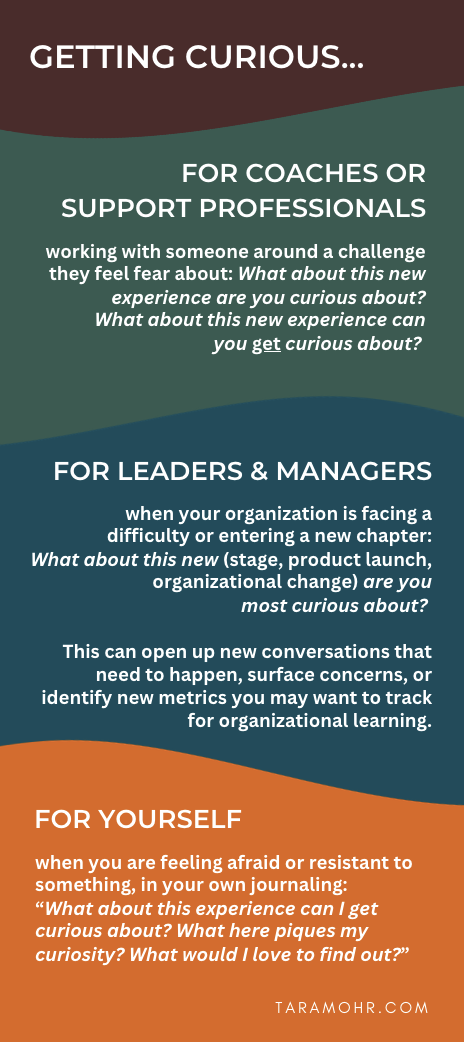
Here’s a few ways you might consider using these questions:
Top Photo Credit: tdub303